
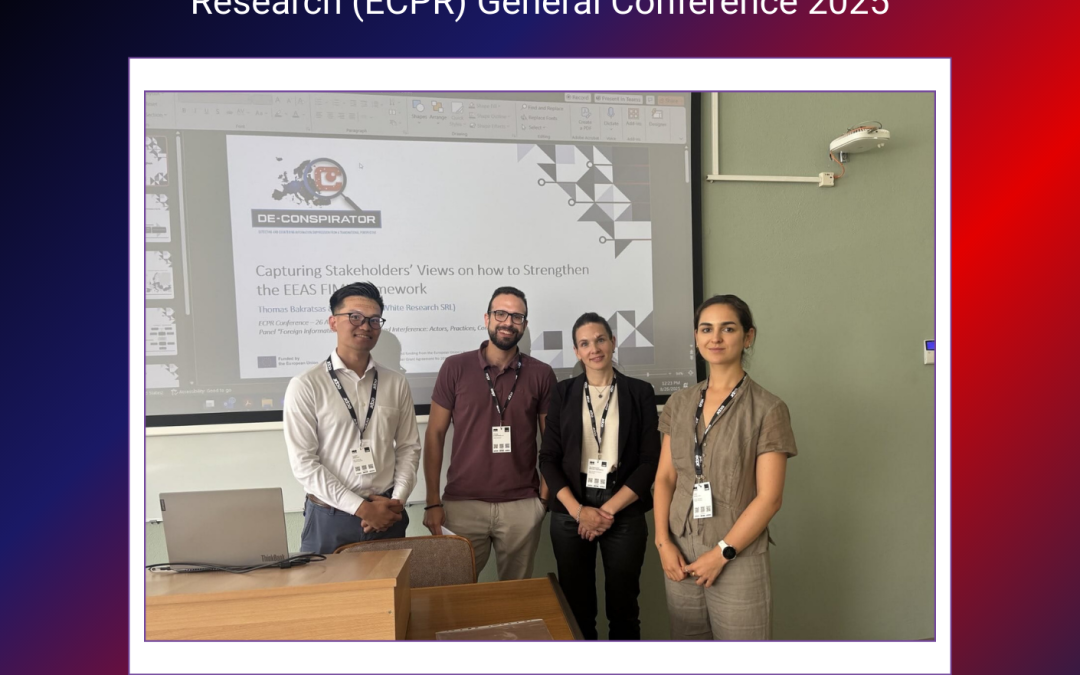
The European Consortium for Political Research (ECPR) held its annual General Conference from 26–29 August 2025 at Aristotle University of Thessaloniki, Greece. This premier event brought together scholars and researchers in political and social sciences to discuss a wide range of sub-disciplines in political science. On day one of the Conference, DE-CONSPIRATOR had the pleasure of hosting the panel: “Foreign Information Manipulation and Interference: Actors, Practices, Concepts.”
The panel brought together three complementary papers exploring different aspects of FIMI tactics, applying both strategic historical analysis and modern detection methods. Our partners Rīga Stradiņš University and White Research presented their papers based on research conducted during the project, while a third contribution from Koç University added an additional perspective, with our project coordinator Akin Unver (Özyeğin University) enriching the discussion through expert commentary as discussant.
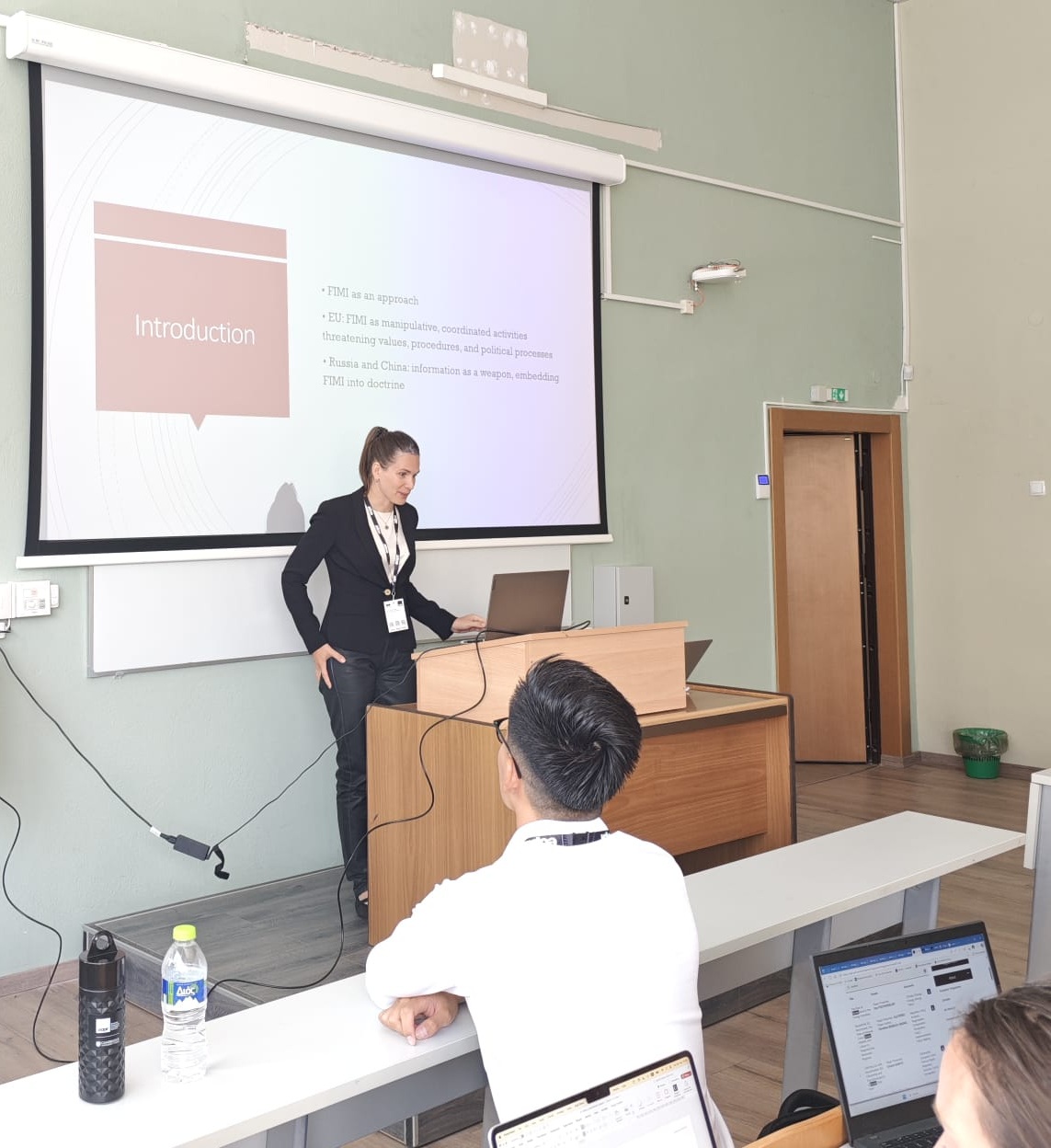
Una Aleksandra Bērziņa-Čerenkova (Riga Stradinš University)
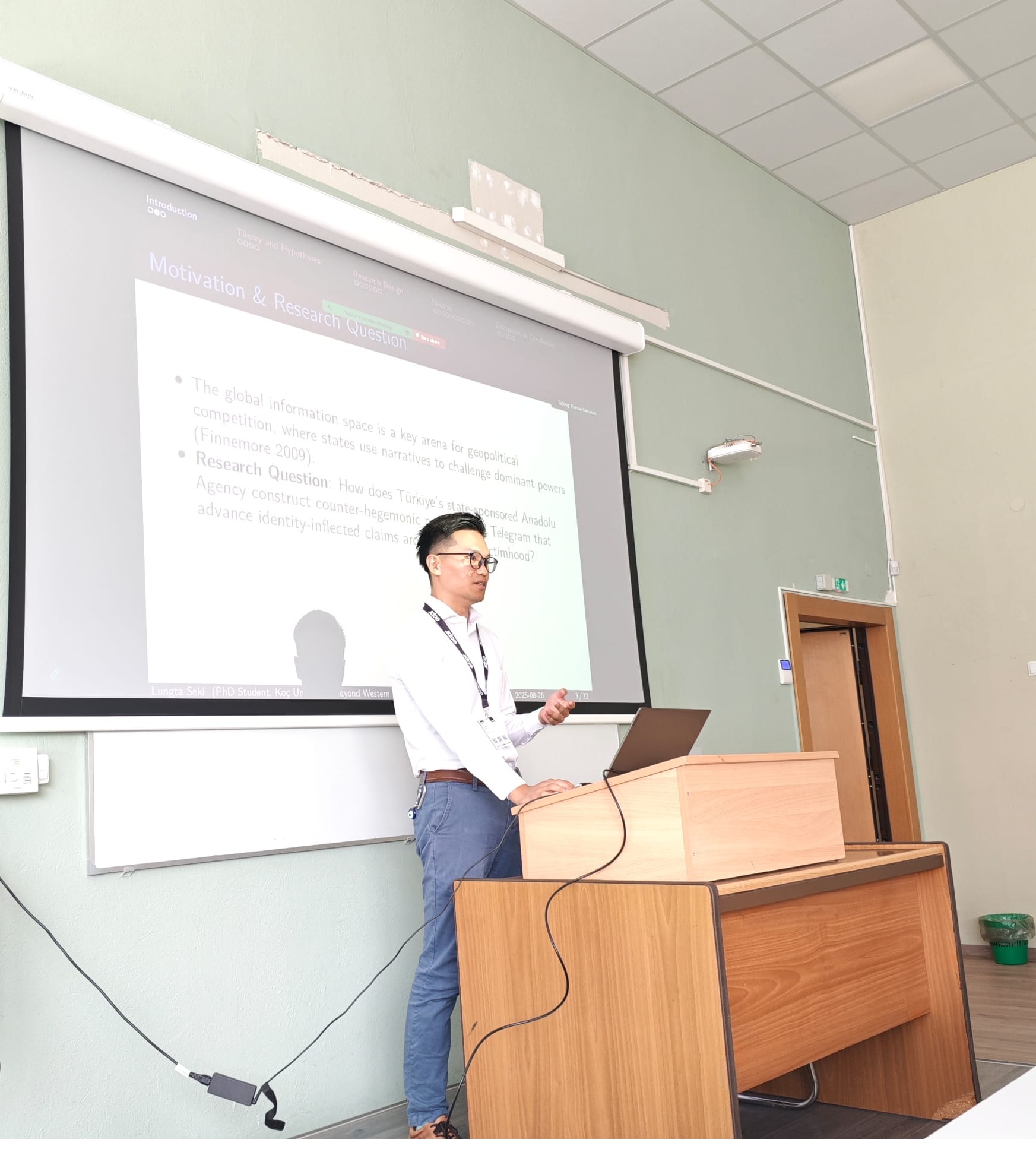
Lungta Seki (Koç University)
Overview of the papers presented during the panel
The following summaries highlight the main research methods, arguments and findings of each paper.
“Capturing FIMI in Strategic and Military Doctrines of Russia and China“
Authors: Una Aleksandra Bērziņa-Čerenkova (Riga Stradinš University); Marina Rudyak (Ruprecht-Karls-Universität Heidelberg)
Presenter: Una Aleksandra Bērziņa-Čerenkova (Riga Stradinš University)
This paper conducts an historical analysis of Russian and Chinese strategic approaches to FIMI. Drawing on official documents, reports, and scholarly literature, it traces the evolution of their doctrines in information warfare and cyber operations. The study identifies key practices and recurring patterns that reveal the objectives behind their interference efforts. These findings help improve the classification and prediction of FIMI tactics in the future.
“In Their Own Words: Capturing Stakeholders’ Views on How to Strengthen the EEAS FIMI Framework“
Authors: Thomas Bakratsas (White Research), Lottie Boas (White Research)
Presenter: Lottie Boas (White Research)
The second paper turns to the European Union (EU) and Partner Countries’ pressing challenges of countering FIMI. Drawing on 21 expert interviews, it addresses gaps in the EU’s FIMI framework – as proposed by the European External Action Service (EEAS), the need to adapt to evolving tactics, and the trade-offs between external defense and domestic censorship. Findings underscore EU preparedness gaps, pointing to practical areas where EU policy can adapt to the fast-changing threat landscape.
“Beyond Western Media Hegemony: Türkiye’s International Media as Illiberal Norm Entrepreneurs“
Author & Presenter: Lungta Seki (Koç University)
This paper showcases how advanced computational methods can improve FIMI detection. By combining political science with computational linguistics, it develops a pipeline that uses large language models and entity extraction to spot disinformation-related entities, narratives, and event. This study contributes to the growing field of automated FIMI detection, addressing critical gaps in the capacity to identify and classify disinformation at scale.
Understanding and Responding to FIMI
Taken together, the three studies provide complementary insights into FIMI, from historical trajectories and present-day policy challenges to cutting-edge detection tools. They contribute to the understanding of how autocracies deploy influence operations and suggest ways by which democratic actors can anticipate, identify, and counter them more effectively.
Building on these exchange, DE-CONSPIRATOR looks forward to continuing its contribution to the academic debate on FIMI.